How to Spot Tether Risks with Signals
Identify and monitor risk factors in your USDT holdings with health signals.
Tether Risk Overview

Tether (USDT) is a cryptocurrency with a value meant to mirror the value of the U.S. dollar. The idea was to create a stable cryptocurrency that can be used like digital dollars. Coins that serve this purpose of being a stable dollar substitute are called “stable coins.” Tether is the most popular stable coin and even acts as a dollar replacement on many popular exchanges! According to their site, Tether converts cash into digital currency, to anchor or “tether” the value of the coin to the pric...
Understanding Tether Risk Signals
Fundamentally provides 7 types of risk signals to help you monitor your Tether (USDT) position. These signals combine your Focus score, market timing (CBBI), and position sizing to alert you when conditions warrant attention.
Risk Signals for Tether
- Concentration Risk: Your USDT position exceeds your bet size range
- Liquidity Risk: Your position is large relative to daily trading volume
- Volatility Risk: Large price swings combined with meaningful position size
- Focus-Timing Mismatch: High Focus but unfavorable market timing
- FOMO Risk: Good timing but low Focus score
- Cleanup Candidate: Very small position with low Focus
- Overweight Poor Timing: Above bet size range during unfavorable conditions
Volatility Context
Tether currently exhibits stable price action with a 24-hour volatility of 0%. As a stablecoin, USDT is designed to maintain price stability, but this doesn't eliminate all risks such as de-pegging events or protocol vulnerabilities.
How Fundamentally Monitors Tether Risks
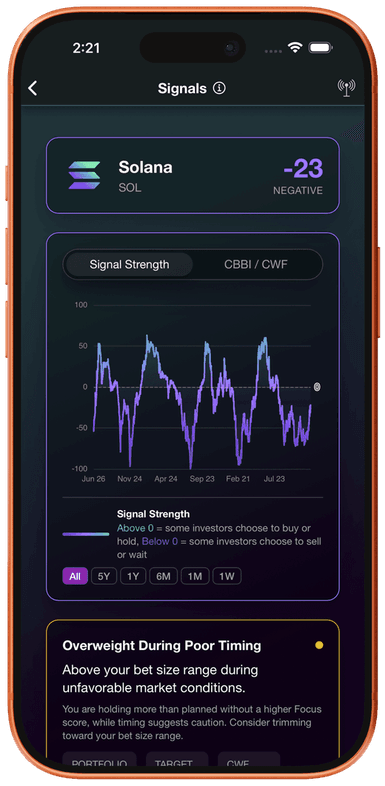
View Your Signals
7 Risk SignalsOpen the Signals page to see which risk signals are active for Tether. Each signal tells you specifically what risk is present in your USDT position.
Understand Each Signal
Clear ExplanationsConcentration Risk triggers when USDT exceeds your bet size range. Volatility Risk signals you to large price swings. Focus-Timing Mismatch warns when market conditions don't favor your position.
Take Informed Action
You DecideUse the Investment Calculator to determine how much Tether to rebalance if needed. Signals are informational—you decide what action to take based on your strategy.
Concentration Risk
Signals when your USDT position exceeds the bet size range based on your Focus score.
Liquidity Risk
Monitors when your Tether position is large relative to daily trading volume.
Volatility Risk
Tracks USDT price swings and signals when volatility affects your position.
Timing Signals
Combines your Focus for Tether with CBBI market timing to identify mismatches.
Frequently Asked Questions
Fundamentally monitors 7 risk signals for Tether: Concentration Risk, Liquidity Risk, Volatility Risk, Focus-Timing Mismatch, FOMO Risk, Cleanup Candidate, and Overweight Poor Timing. These combine your USDT Focus score, position size, and market conditions.
Stablecoins like Tether can lose their peg during market stress or reserve issues. Monitor USDT reserve composition, redemption mechanisms, and historical peg stability when evaluating concentration risk.
Stablecoins like Tether face de-peg risk rather than typical volatility. Monitor USDT reserve health, audit reports, and any deviation from the $1 peg. Concentration Risk still applies if you hold too much in a single stablecoin.
Monitor Tether Risk Signals
Stay informed about risks in your portfolio with Fundamentally's signal system.